Barbizon & patrimoine
Complete Guide to Barbizon: the village that invented Impressionism
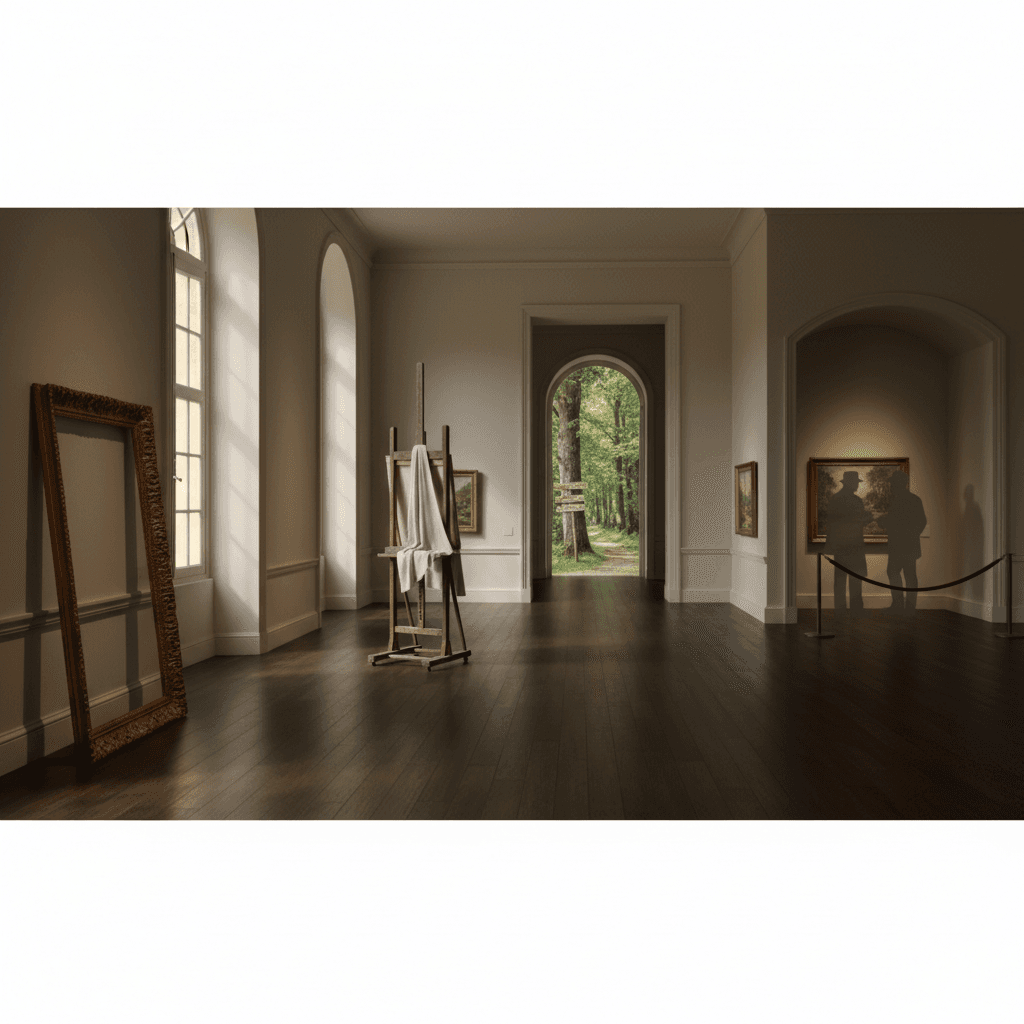
A hamlet between Seine and forest
Sixty kilometres south-east of Paris, nestled against the edge of the Fontainebleau forest, Barbizon fits into a single street: the Grande Rue, a paved nave a kilometre long, lined with inns, studios and low houses covered with weathered tiles. Before 1830, no one yet wrote its name. The village counted three hundred souls, a few cows, a bread oven and a clearing that peasants called the "Bas-Bréau". Then painting arrived.
What we recount here, from the gallery installed at 61 Grande Rue, a few steps from the Ganne inn where it all began, is not a simple chronology. It is the story of a turning point: that of a generation of artists who chose to leave the studio, to abandon the academies, and to go and paint before nature. This decision, taken beneath the oaks of Barbizon, prepared everything that would follow: Impressionism, Post-Impressionism, and, in a certain sense, modern art in its entirety.
The Ganne Inn, 1830: the birth of a school without a school
In 1824, innkeeper François Ganne rents a room to a Parisian painter who has come to study landscapes. Six years later, his house has become the headquarters of an artistic colony whose sole manifesto is a simple, almost naive watchword:
"One must paint what one sees, not what one believes one knows."
This phrase is attributed to Théodore Rousseau, one of the first to settle permanently, in 1848, in a small house on the Grande Rue. Soon circling him are Jean-François Millet, Charles-François Daubigny, Narcisse Diaz de la Peña, Constant Troyon, Jules Dupré. They are not pupils of the same master. They are not members of a proclaimed movement. What they share is an obstinacy: to refuse noble subjects, to abandon mythology, to cease painting Rome when one has the Fontainebleau forest beneath one's feet.
Millet and the dignity of the peasant
Jean-François Millet settles in Barbizon in 1849, with his wife, his children, and almost nothing. He seeks a modest rent and honest light. Both are found here. For twenty-five years, until his death in 1875, he will paint the humblest gestures of the rural world: The Angelus, The Gleaners, The Sower. Canvases that Parisian critics judge "socialist", in the accusatory sense of the term, before they become, half a century later, universal icons.
"Beauty is not in what one represents, but in the need one had to represent it." Jean-François Millet
His studio-home, still standing on the Grande Rue, is today a museum. One can still see, on the wall, the clock he would stare at during sleepless nights.
Rousseau and the forest as cathedral
Théodore Rousseau concerns himself only with trees. He spends entire days, notebook in hand, seeking the oak that will concentrate the whole forest. He paints woodlands as others paint portraits, with an almost religious scruple for each branch, each patch of light filtering through the foliage. It is he who, in 1852, obtains the classification of the Fontainebleau forest as an "artistic series": the first measure of landscape protection in French history. One might say, without exaggeration, that he invented the modern idea of natural heritage.

Corot, the silent traveller
Jean-Baptiste Camille Corot never lived permanently in Barbizon. But he would pass through regularly, always alone, always on foot. He would leave pencil studies there, small clear canvases, silvery, where one recognises his manner: foliage blurred as if seen through a haze of heat, ponds that resemble abandoned mirrors. Young painters would consult him as one consults an oracle.
"Follow no one. I followed no one, and look where it has led me: nowhere in particular, which is perhaps the best thing." Camille Corot
The "motif": painting outdoors, an invisible revolution
It is difficult to measure today how transgressive this was. Before Barbizon, a landscape painter worked from sketches brought back to the studio. He composed, arranged, idealised. Nature was merely raw material that one recomposed in Paris under northern light.
The Barbizon painters did something else. They carried their easels into the clearing. They painted on site, before the landscape, accepting that the light would change, that rain would interrupt, that a blackbird would cross their field of vision. They accepted accident as method. This decision, to paint on the motif as they said, changed everything.
What is transmitted to Impressionism
Twenty years later, when Claude Monet, Pierre-Auguste Renoir or Alfred Sisley came to settle in the environs of Paris to paint in the open air, they walked in the footsteps traced at Barbizon. Without the oaks of Fontainebleau, no Water Lilies at Giverny. Without Millet, no Van Gogh peasants. Without Rousseau, no Cézanne before Sainte-Victoire. This is a direct lineage, and one often claimed: Monet will say of Daubigny that he was "one of the first who understood that one had to paint what one saw". Van Gogh would copy Millet as one recites a psalm.
Today: why Barbizon remains a place of creation
The village has not become a frozen museum. The inns are still there. The Auberge Ganne, transformed into a departmental museum, welcomes nearly fifty thousand visitors each year. The studio-homes of Millet and Rousseau can be visited. But above all, Barbizon continues to attract artists. Painters, sculptors, photographers, sometimes from very far away (Japan, United States, Korea, Netherlands), settle there for a few weeks or for life.
This is the thread we have been trying to continue, at the Galerie Roz In Winter, since 2014. Our monthly programming brings together some twenty contemporary artists, many of them drawn to light, landscape, slow gesture. Some would not have felt out of place at Ganne's table; others work with pixels, zinc plates, textiles. All share, in their own way, the same wager as Rousseau and Millet: to paint what one truly sees.
Seeing Barbizon differently: three moments of a visit
- The Grande Rue, early morning. Start from number 61, go back up to Millet's studio-home. Count the studios still in activity: there are more than one would think.
- The Apremont Gorges path. An hour's walk through the forest, to the rocks that Rousseau and Diaz painted. The winter light, beneath the Jupiter oak, is exactly that of the canvases of 1852.
- The gallery, late afternoon. See how today's artists (painting, sculpture, jewellery, photography) dialogue with this heritage. Certain works in our catalogue, marked out in the itinerary, directly evoke Barbizon, the forest, the light of Île-de-France.
To go further
The Musée départemental de l'École de Barbizon (Auberge Ganne, 92 Grande Rue) holds the finest collection of works and objects related to the colony: palettes, letters, caricatures engraved by the painters themselves on the walls of the rooms. It is open from Wednesday to Sunday, free entry on the first Sunday of the month.
Théodore Rousseau's studio-home, reopened after a restoration campaign in 2023, shows the studio in its original state. One understands there, better than in any book, what it meant, in the nineteenth century, to live from one's painting.
And if you have only two hours to spend in Barbizon, spend them here: come down to number 61, push open the gallery door. We will tell you, before the works, the rest of the story. The one that continues to be written, right now, in the studios of the village.