Guide du collectionneur
Tax relief on art purchases for your business: the complete guide to the Aillagon law
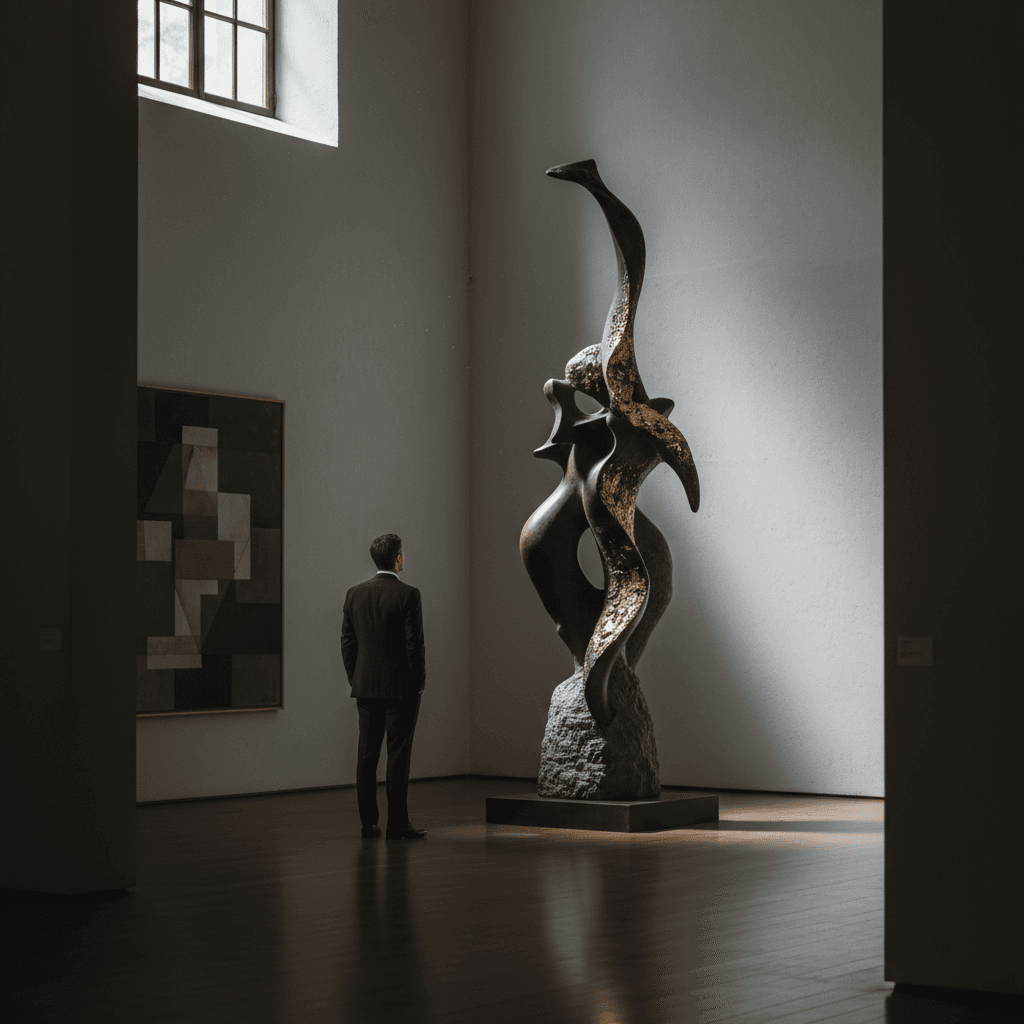
An underutilised scheme
Buying an artwork for your business, displaying it in your premises, and deducting the investment from your taxable profit: this is precisely what Article 238 bis AB of the French General Tax Code, known as the "Aillagon law", has provided for since 2003. Twenty years later, the scheme remains largely unknown to SME managers and liberal professionals.
This guide explains the mechanism, its conditions, its calculation, its limitations, and what it concretely represents for a business with a turnover of 1 to 10 million euros, the segment where it is most relevant.
The principle in two sentences
A business subject to corporation tax (IS), or to income tax in the BIC category, may deduct from its taxable profit the acquisition price of original works by living artists, spread equally over 5 years, within an annual ceiling limit.
This ceiling: 0.5% of turnover excluding VAT, reduced by donations under patronage. If the deduction for a given year exceeds the ceiling, the excess cannot be carried forward. Hence the importance of calibrating acquisitions each financial year.
Who can benefit
Eligible parties are:
- Businesses subject to corporation tax (SAS, SARL, SA, SCA, etc.).
- Sole traders and partnerships under BIC on an actual basis.
Not eligible:
- Liberal professions under BNC (solicitors, doctors, architects in independent practice). The Aillagon law does not cover BNC. A professional limited company (SEL) under IS or a professional property company (SELARL) under IS, by contrast, may benefit.
- Associations not subject to commercial taxes.
Often forgotten point: a holding company under IS which owns offices leased to the operating company may also acquire artworks and apply the scheme, provided the work is displayed in an accessible location.
The strict conditions to observe
Three conditions, all mandatory:
- Artist living on the date of acquisition. Purchasing a work by a deceased artist does not entitle you to any Aillagon benefit (other schemes exist, more restrictive, for older works).
- Original work: painting, sculpture, drawing, engraving, art photography (signed limited edition), tapestry. Reproductions, unnumbered multiples and decorative works without signature are excluded.
- Public exhibition or display to staff for 5 years, in an accessible location: reception hall, meeting room, shared office, lobby. The work cannot be kept in the manager's personal office nor in a private residence.
The work must be recorded on the company's fixed assets, under account 218 (other tangible fixed assets).
The calculation: a concrete example
Take an SME with 2,000,000 € turnover excluding VAT purchasing a work for 15,000 € excluding VAT.
| Step | Calculation | Amount |
|---|---|---|
| Annual ceiling | 0.5% × 2,000,000 € | 10,000 € per annum |
| Theoretical deduction | 15,000 € ÷ 5 years | 3,000 € per year |
| Compared to ceiling | 3,000 € < 10,000 € | OK, fully deductible |
| Tax saving (IS at 25%) | 3,000 € × 25% × 5 years | 3,750 € over 5 years |
In other words, on a 15,000 € artwork, the State reimburses 3,750 € through reduced tax. Net cost after tax: 11,250 €, with the work remaining full property of the company and valued in its assets.
More ambitious case, same turnover, acquisition at 50,000 €:
- Theoretical annual deduction: 50,000 / 5 = 10,000 €
- Ceiling: 10,000 € → exactly within the ceiling
- Tax saving: 50,000 × 25% = 12,500 € spread over 5 years
Beyond this, you must either split the acquisition over two financial years, or accept losing the portion exceeding the ceiling. A good gallery knows how to build an optimised acquisition calendar.
The formalities: less burdensome than it appears
There is no specific Aillagon form, nor prior approval request. The procedure amounts to three steps:
- On acquisition: the gallery issues a bill in the company's name (with its SIRET and VAT number). The work is capitalised under account 218.
- At year-end: the extra-accounting deduction is reported on form 2058-A (corporation tax return), "Various deductions" line, box XG. A free note annexed to the accounts recalls Article 238 bis AB and specifies the artist's name, the work, and the price.
- For 5 years: retain supporting documents (invoice, certificate of authenticity, photo of the work displayed in premises). In the event of an audit, the authorities verify the work's accessibility.
Your accountant probably knows the scheme; if not, Article 238 bis AB and BOI-BIC-CHG-70-10 from the Official Bulletin of Public Finances provide the full guidance.
Beyond the tax aspect: why it is worth doing
Reducing tax by 25% would be sufficient to justify the acquisition. The interest goes further:
- Working environment. An original work transforms a hall, meeting room, or open space. The effect on how colleagues, clients and partners perceive the company is immediate, and incomparable to a poster.
- Corporate culture. Acquiring an artist also tells something about the company: its relationship with the long view, the gesture, the unique. Several of our clients have made it an internal thread (a new acquisition each year, presented at the annual general meeting).
- Patrimony value. The work remains an asset, does not depreciate like IT equipment, and can appreciate if the artist gains in value. After 5 years, it can be retained, resold, or transferred to the manager (with corresponding tax consequences).
- Soft sponsorship. Supporting a living artist means funding contemporary creation. This is not patronage in the strict tax sense, but the impact on the ecosystem is real.
A case study with Galerie Roz In Winter
We regularly support businesses on this type of acquisition. Our standard proposal for a first approach:
- Visit to your premises or exchange of plans and photos to identify possible locations (light, format, height).
- Pre-selection of works corresponding to the Aillagon budget optimised for your business turnover.
- Final selection at the gallery, if possible in the presence of the manager or decision-makers.
- Invoicing to your company SIRET, certificate of authenticity, delivery and installation included.
- Explanatory note sent to your accountant for the deduction over 5 years.
We also offer a buyback undertaking at 50% of purchase price from the 5th year onwards, for businesses wishing to refresh their collection. This option does not affect the tax benefit (any eventual sale will simply generate taxable income at the time of realisation).
Discuss it directly
If you are a SME or professional practice manager and this scheme interests you, the simplest thing is to discuss it directly. We arrange meetings at the gallery, in Barbizon, or we travel to Paris for acquisitions over 10,000 €. An hour is enough to review your situation, your ceiling, and present three or four suitable options.
Business contact: artistesrozinwinter@gmail.com · +33 6 10 71 13 25