Guide du collectionneur
How to Choose Your First Artwork
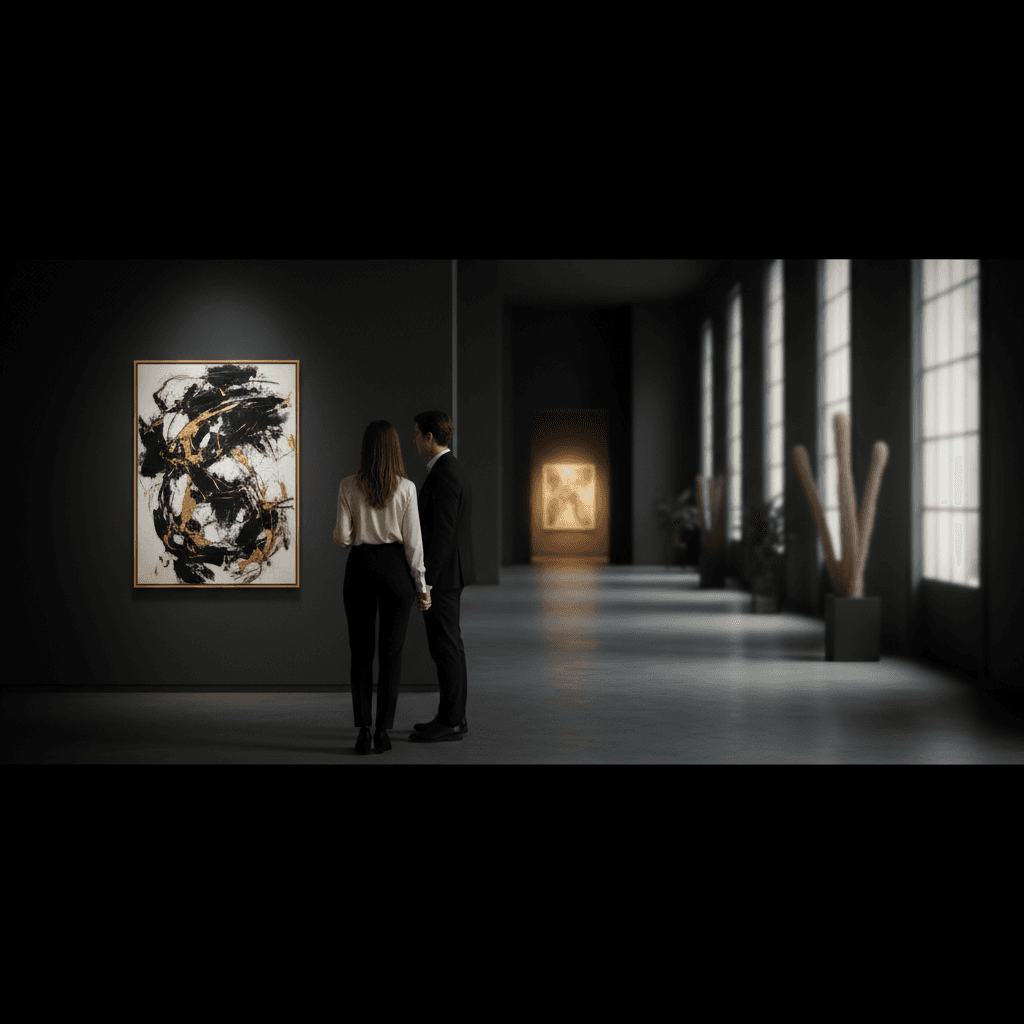
Before You Begin: Forget What You Think You Know
Most collectors we work with at the gallery did not start by asking themselves what to buy. They started by asking whether they were entitled to buy. This doubt is the only thing to set aside from the outset.
You don't need a degree in art history. You don't need a five-figure budget. You don't even need a drawing room. What you need is an eye. And the eye develops through looking. That's all.
This guide is for those considering their first acquisition. We have built it around five stages, the ones we walk through daily with our visitors. None of them is technical. All of them require time.
Stage 1: Look Much, Buy Slowly
You don't choose a work of art the way you choose a piece of furniture. You must let your eye tire, then return. The rule we often give: see at least thirty works before deciding on one. This may take an afternoon, a season, sometimes a year.
Where to look?
- Galleries, of course. But also art fairs (Drawing Now, Art Paris, Réalités Nouvelles) where you see in one day what would take months to see otherwise.
- Museums: they train the eye to a standard that no auction house can replace. Visit the Louvre, the Quai Branly, Beaubourg, the Abattoirs in Toulouse, Fontainebleau.
- Open studios, when available. There is no more powerful school of collecting than meeting an artist directly at work.
The more works you see, the more you will distinguish what, for you, makes the difference. It is not a general taste you need to develop, but your taste.
The Return Test
A work that pleases you at first sight can bore you in three weeks. A work that intrigues you, that makes you uncomfortable at first, that demands an effort from you, may accompany you for twenty years. When you think you have found the right piece, wait a few days, go back and see it, observe whether it continues to work within you. It's the best indicator we know.
Stage 2: Set an Honest Budget
There is no "right" budget for a first work. There is a budget that is possible, one that doesn't put you in difficulty and doesn't leave you frustrated either.
Our benchmarks, for a first contemporary acquisition:
- €200 to €800: a print, a signed lithograph, a limited edition photograph, a small drawing. Perfectly legitimate, often underestimated. Many major collections begin this way.
- €800 to €3,000: a unique work of medium format (painting, mixed media, small-scale sculpture) by an emerging or mid-career artist.
- €3,000 to €10,000: the heart of accessible contemporary art market. Established artists, represented by galleries, sometimes already in public collections.
We advise never borrowing to buy a work of art (except 0% credit over a short period that some galleries, including ours, offer). A work bought in anxiety does not bring the same joy as one bought in serenity.
The True Cost of a Work
To the price of the work, add:
- Possible professional framing (€80 to €400 depending on format and frame type).
- Careful hanging: a good brass wall hook, possibly two for balance.
- Revised home insurance if your accumulated artworks exceed a certain threshold (typically €2,500 excluding furniture for standard policies).
These secondary costs, added together, are never negligible. Better to anticipate them.
Stage 3: Research the Artist (Without Overdramatising)
Buying a work of art means buying the work of a person. Taking ten minutes to understand that work makes all the difference.
The questions we recommend asking, either at the gallery or directly with the artist:
- What is the approach? What is being explored in this body of work? Where does this particular work sit in their trajectory?
- What are the exhibitions, publications, recognised public or private collections? This is not a quality criterion, but an indicator of seriousness.
- What is the exact technique? How many copies for a print? What edition? What materials?
- How is the artist represented? By a gallery, several galleries, directly from the studio? This determines future traceability.
The gallery must be able to answer each of these questions without hesitation. If not, that's a signal.
Stage 4: Verify Documents
A work bought from a reputable gallery is always accompanied by:
- A detailed invoice bearing the title, date, technique, dimensions, price excluding and including VAT, the name of the seller and the buyer.
- A certificate of authenticity signed either by the artist or by the gallery acting as agent. This document mentions the edition number for limited prints.
- A provenance file, for second-hand works: past exhibitions, publications, previous owners if disclosable.
At Roz In Winter Gallery, we systematically provide these three elements. Since 2025, we add a discreet NFC chip integrated into the back of the frame, which directs to the digital filing sheet of the work. This sheet is updated in case of resale, restoration or loan to an exhibition. It is a guarantee of traceability for the entire life of the work.
We detail this system in a dedicated article; if you are thinking about your first acquisition, take a few minutes to read How to Ensure the Authenticity of a Contemporary Artwork.
Stage 5: Live With the Work
This is the stage we talk about least, and it may be the most important.
A work you buy ends up on a wall. Or resting on a shelf. Or in a corridor where you pass it ten times a day. Its place in your daily life is a separate decision in itself.
A few principles we pass on:
- Light. Avoid direct sunlight, which damages pigments and papers. Prefer indirect exposure, or LED lighting at 3,000 K set at a moderate intensity.
- Humidity. Watercolours, prints, old photographs fear humidity. 45 to 55% relative humidity is ideal. Avoid walls adjacent to a bathroom.
- Height. The classic rule: the centre of the work at 1.45 m from the floor. In practice, adjust according to ceiling height and room function. A painting viewed from a sofa is not hung at the same height as one you pass walking through a corridor.
- Spacing. Don't overcrowd your walls. A work breathes only if you leave emptiness around it.
The Mistake You Make Only Once
Buying a work to match a sofa. The sofa will be gone in five years. The work will remain, if it's the right one, for thirty, forty, sixty years. Choosing based on furniture that goes out of fashion is to approach the problem backwards.
In Summary
A first work is not a financial investment. It is a commitment: you accept bringing into your life the work of someone else, and granting them, each day, a little of your attention. If this pact seems right to you, you are ready.
We receive visitors at the gallery, by appointment, who are in the midst of reflection. You can come and look without immediate intention to buy; we often discuss it, and it's always useful, for both sides.
Our current selection is online on the page My Selection. It brings together the works we are accompanying right now, with precise price ranges. It may be the best starting point for a first visit.