Guide du collectionneur
How much does an original artwork cost? A pricing guide for collectors
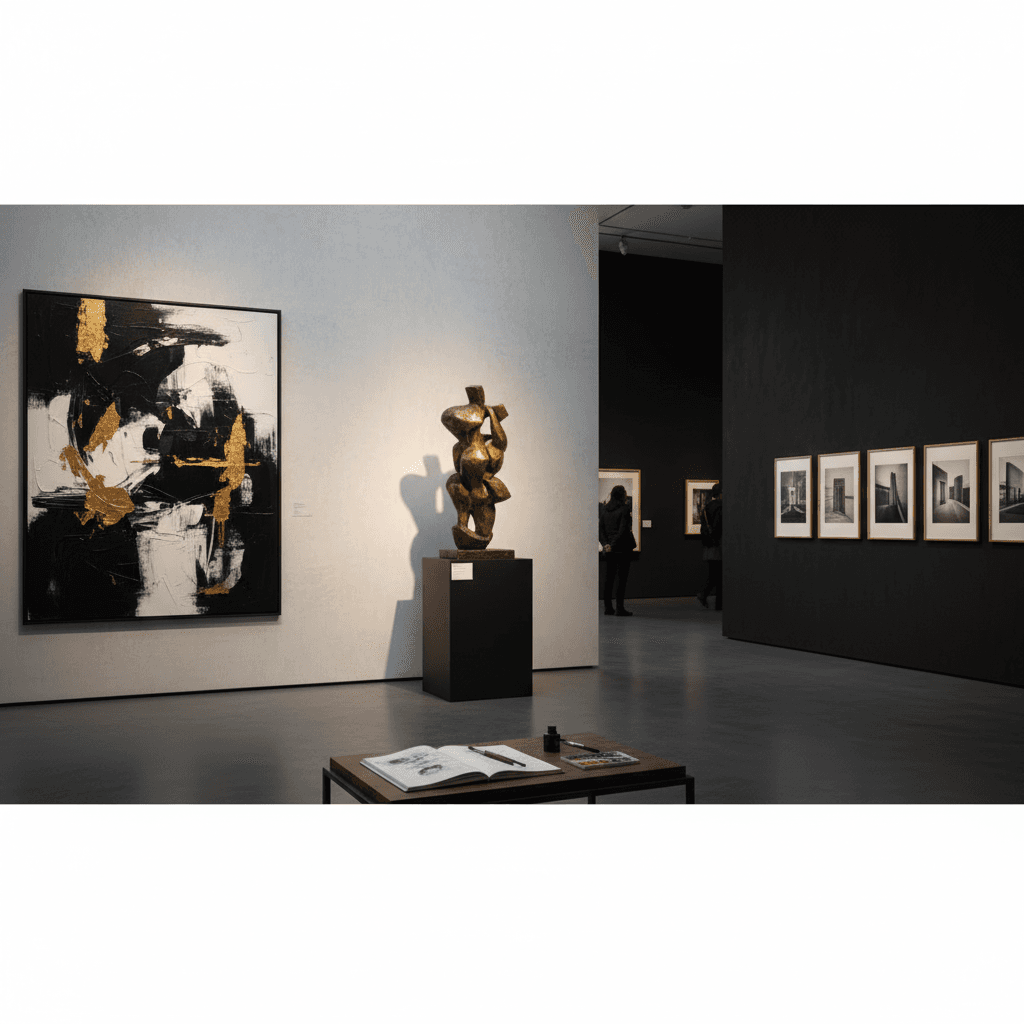
A misconception worth dispelling
« Original art isn't for me. » That's the phrase we hear most often at the gallery threshold, just before a visitor leaves with their first artwork under their arm. The misunderstanding is persistent: contemporary art is not reducible to Christie's sales, and the price gap between a poster and an original artwork is often slimmer than one might imagine.
This guide has a single aim: to give you realistic orders of magnitude, medium by medium, so you can budget for a first purchase (or gift) with full knowledge of the facts.
What truly determines an artwork's price
Four criteria carry weight, in this order:
- The artist's reputation. An artist exhibited in museums, present in public collections or prize-winner at recognised salons will command a higher valuation. It's mechanical.
- The medium and working time. An oil on canvas of 80 × 100 cm represents several hundred hours of work; an ink drawing, considerably less.
- The format. Price rarely progresses in linear fashion with surface area. A 50 × 50 cm is not double a 25 × 25.
- The distribution channel. A gallery typically applies a margin of 40 to 50% which covers artist support, opening events, advice, expertise, provenance guarantee. Buying directly from the studio sometimes costs less, but without the accompanying services.
To this add the year of creation (a recent piece often costs less than an earlier work by the same artist), the edition (unique piece or limited edition), and market status on the secondary market.
The pricing grid, medium by medium
The ranges below reflect what we charge and what we observe in comparable galleries. They concern represented contemporary artists, neither amateurs nor internationally recognised stars.
| Medium | Small format (< 30 cm) | Medium format (30–80 cm) | Large format (> 80 cm) |
|---|---|---|---|
| Drawing / watercolour | 200 – 600 € | 400 – 1 200 € | 800 – 2 000 € |
| Engraving, screen-print (limited edition) | 150 – 400 € | 300 – 900 € | 600 – 1 500 € |
| Oil / acrylic on canvas | 500 – 1 500 € | 1 200 – 4 500 € | 3 500 – 15 000 € |
| Art photography (limited edition, signed) | 300 – 900 € | 600 – 2 200 € | 1 800 – 5 000 € |
| Sculpture (bronze, resin, clay) | 800 – 2 500 € | 2 000 – 5 000 € | 4 500 – 8 000 € + |
| Artisanal jewellery, unique piece | 150 – 600 € | 500 – 1 200 € | 800 – 2 000 € |
These ranges are broad, deliberately so: they cover the gap between a talented emerging artist and an established one. For a given budget, it is often better to choose a fine piece by an emerging artist than a small one by an established name. It's also the philosophy of a collection built over time.
Emerging, established, indexed: what changes
- Emerging (fresh from school, early exhibitions): entry-level pricing, pleasure in supporting an artistic journey. Moderate risk: the valuation may stagnate, but the artwork retains its use value.
- Established (built career, multiple galleries, press coverage): price +50 to +200% compared to emerging. A « safer » acquisition, recognised signature.
- Indexed (present in Artprice databases, regular auction sales): prices indexed to the secondary market, tracked and publicly searchable. Often beyond 8 000 € for a major work.
Our advice for a first purchase: an emerging or established artist, never an indexed one. You buy first to live with the artwork, not to speculate.
What is (or should be) included in the price
In a reputable gallery, the displayed price includes:
- A certificate of authenticity signed by the artist, dated, numbered.
- Traceability: provenance, exhibition history, nominal invoice.
- Pre-purchase advice, and afterwards, for hanging, framing, maintenance.
- The possibility of exchange or return according to gallery policies (often within 30 days).
Not necessarily included:
- Framing (80 to 400 € depending on format and glass choice).
- Home delivery (complimentary above a certain amount with us; check elsewhere).
- Transport insurance for fragile pieces.
Always ask for a detailed quote distinguishing artwork, framing, delivery.
How to assess whether a price is fair
Three simple checks:
- Compare within the same gallery, at equal technique and format. The internal consistency of a catalogue says much.
- Verify the artist's presence at other salons, in specialised press, in public collections. A reputable gallery will supply these details without hesitation.
- Ask whether the artist has a public valuation on platforms such as Artprice. For an emerging artist, it is normal to have none. It's even rather reassuring: the price comes from the work, not speculation.
An artwork that's « too expensive » is rarely the issue. An artwork whose price you cannot fathom always is. Ask the question.
Where to start, practically speaking
If you are considering your first purchase without a preset budget, we generally suggest:
- Under 500 €: a drawing, a watercolour, an artist's engraving. Intimate format, ideal for an office or entrance.
- Between 500 and 1 500 €: a small painting, a photograph in limited edition, a small-format sculpture, a unique artisanal jewellery piece. The densest segment of our catalogue, the best entry point for a considered first acquisition.
- Between 1 500 and 5 000 €: a masterwork by an emerging artist or a medium-format piece by an established artist. At this level, the artwork becomes an anchor point in a room.
- Beyond 5 000 €: large-scale pieces, imposing-format sculptures, works by established artists. Often decided over multiple visits.
See before you buy
The best way to calibrate a budget remains to look, compare, view (with a discerning eye). Galerie Roz In Winter's online catalogue displays the prices of all available artworks; we also welcome appointments for acquisitions from 1 500 € onwards. It's an opportunity to present several pieces side by side, in the gallery's light, something no screen can replicate.
Discover the collection: galerierozinwinter.com/artworks.